THE WALKING Practice
Walking is not a break. It is the default state.
The Walking Practice is a clearly defined, guided process of perception, thought, and alignment, with conscious walking at its core. A challenge, a strategic question, a goal, are the starting point. Individual insights, condensed into a common sense and direction, are the result.
Inquire now
No hike.
No wellness retreat.
No mindfulness practice as an end in itself.
What is it? Let this landscaping comparison sink in:
Most of us arrive and ask, „What should we grow here?“ We start with the question, „What grows here?“
When what is within us and what is outside come together, we create visions and solutions that can be supported by everyone.
How can walking support shared thinking and decision-making processes?
Walking can support the development of new ideas and enable a shift away from familiar patterns of thinking and conversation. For this to result in joint decisions, it subsequently requires discussion, evaluation, and a clear agreement on the next steps.
Oppezzo and Schwartz's experiments demonstrate the benefits of walking when developing diverse, new ideas. It does not follow that every thinking task or the quality of group decisions is improved across the board. Oppezzo & Schwartz, 2014
My format The Walking Practice combines movement with a guided perception and alignment process:
- MOVE: A common question forms the starting point. We deliberately set ourselves in motion.
- NOTICE: While walking, initially in silence, we perceive which thoughts, feelings, and perspectives arise. The question is carried along without having to force a solution immediately.
- ALIGN: In the moderated exchange, individual insights are brought together, related to the initial question, and translated into shared priorities and concrete contributions.
The benefit for the team lies in this combination of individual perception and shared alignment. New ideas are given space; subsequently, it is clarified which of them are viable and who will take on which next step.
In which setting can The Walking Practice be used?
The Walking Practice is suitable for Team outings, leadership offsites, and strategic retreats, that focus on a shared question. The format combines mindful walking, individual perception, and moderated exchange to translate insights into a shared direction.
Typical application areas are:
- Strategic alignment: What future do we want to shape, and what priorities emerge from that?
- Team development: What strengths do individuals bring, and how do we use them for a common goal?
- Change processes: What is changing right now, what will we need in the future, and what contribution can every person make?
- Executive development: How do we want to lead, collaborate, and take responsibility?
- Project kickoffs and status assessments: Where do we stand, what do we want to achieve, and what are we agreeing on for the next steps?
As a spatial setting, a quiet environment close to nature with easily walkable paths and a suitable location for subsequent discussion is ideal. The route and pace are tailored to the participants.
The Walking Practice can be used as a standalone format or as part of a broader development process. What is crucial is a relevant shared question – and the willingness to develop joint action steps from individual insights.
THE METHOD: MOVE - NOTICE - ALIGN
The Walking Practice is also anchored in the Charisma Concept, which always aims for the congruent alignment and conscious further development of mind - body - communication*. (*We talk about „communication“ in the context of the charisma-concept, when we are referring to behavior, because behavior is a form of communication )
MOVE
A question, a problem, a vision. Conscious, guided walking.
The body comes into motion. "Walking" out of the usual frame of mind.
NOTICE
Perception of what emerges: thoughts, ideas, feelings, energy, personal strengths.
No judging, letting flow, enjoying, being inspired by the self.
ALIGN
Moderated exchange, consolidation of findings, and translation into clarity.
From individual perception to collective alignment.
”The Walking Practice uses nature not for relaxation as an end in itself, but as a restorative thinking space: to regenerate attention, foster insights, and subsequently create shared alignment.
Martina Gleissenebner-Teskey
The result
Shared Vision
A clear vision for our future collaboration.
Focus & Priorities
Few, jointly supported focal points instead of parallel agendas
Strength Map
We come to SEE what everyone brings to the table.
Commitment
A concrete, personal contribution from each team member.
Difference between the various walking formats
Movement, activity, and a shared nature experience are at the center.
A topic is being discussed and resolved during the walk.
Attention is most often drawn to the breath or the stride itself
Attention is initially relieved; a relevant question is carried openly and then jointly condensed.
This is what science says
Why walking in nature can be more than just a break
Nature is not a backdrop in The Walking Practice, but part of the method.
Research on the so-called Attention Restoration Theory suggest that natural environments require less of our voluntary attention than urban, stimulus-intensive spaces. In a controlled study, performance on a working memory task improved significantly more after a roughly 50-minute nature walk than after an equally long city walk. A recent meta-analysis of 80 studies confirms small but reliable benefits, particularly for working memory and attention control – especially after mental fatigue.
The Walking Practice consciously utilizes this restorative in-between space: After a brief physical alignment, a relevant question is carried in silence – not actively solved. Thoughts, perceptions, and impulses are allowed to arise without immediate judgment or discussion. Only after this are individual insights shared within the team and condensed into a common perspective.
This way, nature doesn't become a retreat from thinking, but a new space for thinking.
- Kaplan, Stephen (1995).
The Restorative Benefits of Nature: Toward an Integrative Framework.Journal of Environmental Psychology, 15(3), 169–182. - Berman, Marc G.; Jonides, John; Kaplan, Stephen (2008).
The Cognitive Benefits of Interacting With Nature.Psychological Science, 19(12), 1207–1212. - Bell, Cameron N.; St George, Rebecca; Honan, Cynthia; Bell, Lachlan J.; Jolly, Alex T. W.; Matthews, Allison (2025).
The Relationship Between Nature Exposures and Attention Restoration, as Moderated by Exposure Duration: A Systematic Review and Meta-analysis.Journal of Environmental Psychology, 104, 102632. - Basu, Avik; Duvall, Jason; Kaplan, Rachel (2019).
Attention Restoration Theory: Exploring the Role of Soft Fascination and Mental Bandwidth. (Environment and Behavior, 51(9–10), 1055–1081. - Oppezzo, Marily; Schwartz, Daniel L. (2014).
Give Your Ideas Some Legs: The Positive Effect of Walking on Creative Thinking. (Journal of Experimental Psychology: Learning, Memory, and Cognition, 40(4), 1142–1152.
Why does The Walking Practice need professional guidance?
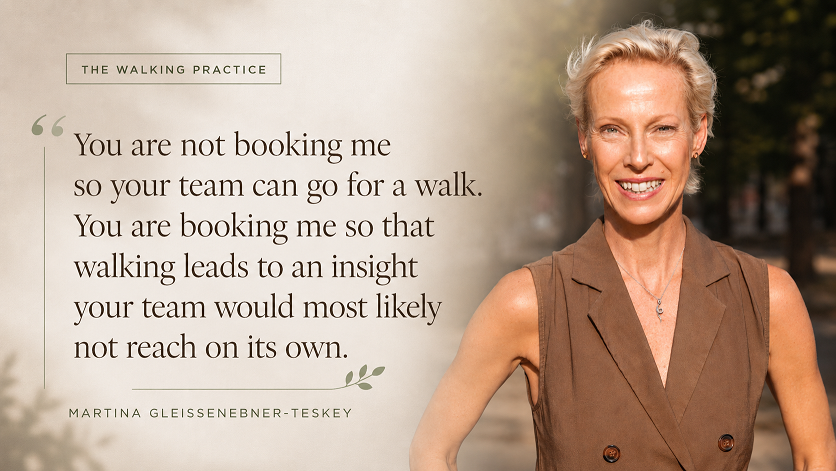
Every team can walk together. But walking alone does not create clarity, a shared vision, or sustainable change.
The Walking Practice is therefore not a walk followed by a conversation. It is a carefully designed development process: with a clear question, a guided shift in attention, a protected space for individual insights, and a professionally facilitated integration of the results.
The facilitation ensures that participants do not merely repeat their known thoughts. They are guided out of familiar conversation patterns, hierarchies, and roles, gaining access to perspectives that often remain hidden in traditional meetings.
The real value, therefore, lies not in the walking itself, but in what becomes visible, discussable, and decidable through it.
The Walking Practice turns movement into insight – and insight into collective action.