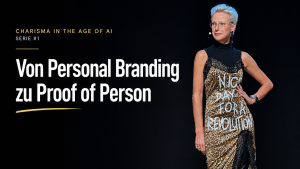
Who would have thought that the age of AI, of all times, would make my core topic of „charisma“ so relevant?
I have always understood charisma and personal branding as two sides of the same coin. A strong personal brand gains impact through charisma. And charismatic people often develop something very similar to a personal brand: people remember them, talk about them, refer to them, and automatically associate certain topics with them.
For me, the crucial difference lies in the goal. And the goal determines the approach.
When I want to build a personal brand, I ask myself:
-
- what do I want achieve? ⇒ measurable goals
- what special characteristics, competencies, and skills can I use for this? ⇒ Unique Selling Proposition
- How do I become visible to the right people? ⇒ Select communication channels, manage them, and measure their impact
The perspective of personal branding is therefore initially person-centered: What goal do I want to achieve, what do I want to stand for, and how do I make that visible to others?
If I, on the other hand, want to develop my Charisma I'll start at a different point:
- who am I, beyond what I have learned, adopted, and acquired? ⇒ Self-awareness
- what does the world around me need and what place do I occupy in it? ⇒ systemic perspective
- how can I act consciously to make my contribution? act consciously to change/further develop the system ⇒
Personal branding therefore helps us achieve concrete goals. Charisma development goes beyond that, asking what impact we want to have on people, relationships, and systems.
Both create an effect. Both can have a big impact. But the starting point and objective are different. For more than 30 years, I have been working with both perspectives and supporting people in becoming more visible, distinctive, and credible, and in consciously helping to shape their living and working systems. And now AI is changing the rules of the game. Interestingly, this primarily affects the classical side of personal branding first.
Because when almost anyone can generate professional content, compelling images, and seemingly wise opinions within seconds, some of our previous signals for competence and personality lose their significance.
- Content is no longer 𝗽𝗿𝗼𝗼𝗳 𝗼𝗳 expertise.
- Perfection is no longer 𝗽𝗿𝗼𝗼𝗳 𝗼𝗳 competence.
- Visibility is no longer 𝗽𝗿𝗼𝗼𝗳 𝗼𝗳 presence.
And with that, a completely different question suddenly arises:
What makes YOU unique and credible?
A current development at the European level makes clear how relevant this question has already become. Since August 2, 2026 the transparency obligations under Article 50 of the EU AI Act apply. Among other things, they concern the recognizability of certain interactions with AI as well as certain AI-generated or manipulated content. At first glance, this is a regulatory matter. For me, however, this development signals something much larger for brands, executives, and anyone who communicates publicly:
Human Presence is becoming more valuable.
For years, personal branding was heavily about visibility: sharing expertise, creating content, building reach, developing a distinct voice. AI has fundamentally changed the conditions for this. It can write articles, create presentations, generate photos and videos, and formulate professional LinkedIn posts. And it is getting increasingly better at producing something that looks and sounds strikingly like you.
What makes it all the more valuable at the same time is that which cannot simply be generated:
the person behind the words.
For me, this development leads to one of the decisive currencies of the AI age:
PROOF OF PERSON
- Can I see who is making the decision?
- Is there a comprehensible standpoint recognizable behind the words?
- Would this person say the same thing in a meeting or in a private conversation?
- Can (s)he explain her/his reasoning when asked?
- Is (s)he ready to take responsibility for her/his contributions?
The easier it is for machines to produce persuasive communication, the more valuable become judgment, taking a stance, willingness to take responsibility, consistency, and genuine human presence.
Nevertheless, personal branding will not disappear. On the contrary. But its meaning will change. It will no longer be enough to be visible, to communicate professionally, and to develop a recognizable style. We must, as human beings, become comprehensible : in our attitude, our decisions, and our actions.
And this is precisely where for me Charisma in the Age of AI becomes relevant again.
Not as a special gift given to a few people. But as the ability to know oneself, to develop one's own standpoint, to relate to others, to take responsibility, and to make an impact with one's actions. Perhaps that is precisely why a technology that can imitate us ever more perfectly will lead us to deal much more intensively with the question:
What makes us distinctively human?
I will explore this question from various perspectives in the coming weeks – also in preparation for my new book.
CHARISMA IN THE AGE OF AI
And for those who want to take this topic further within companies, leadership, or personal branding: